


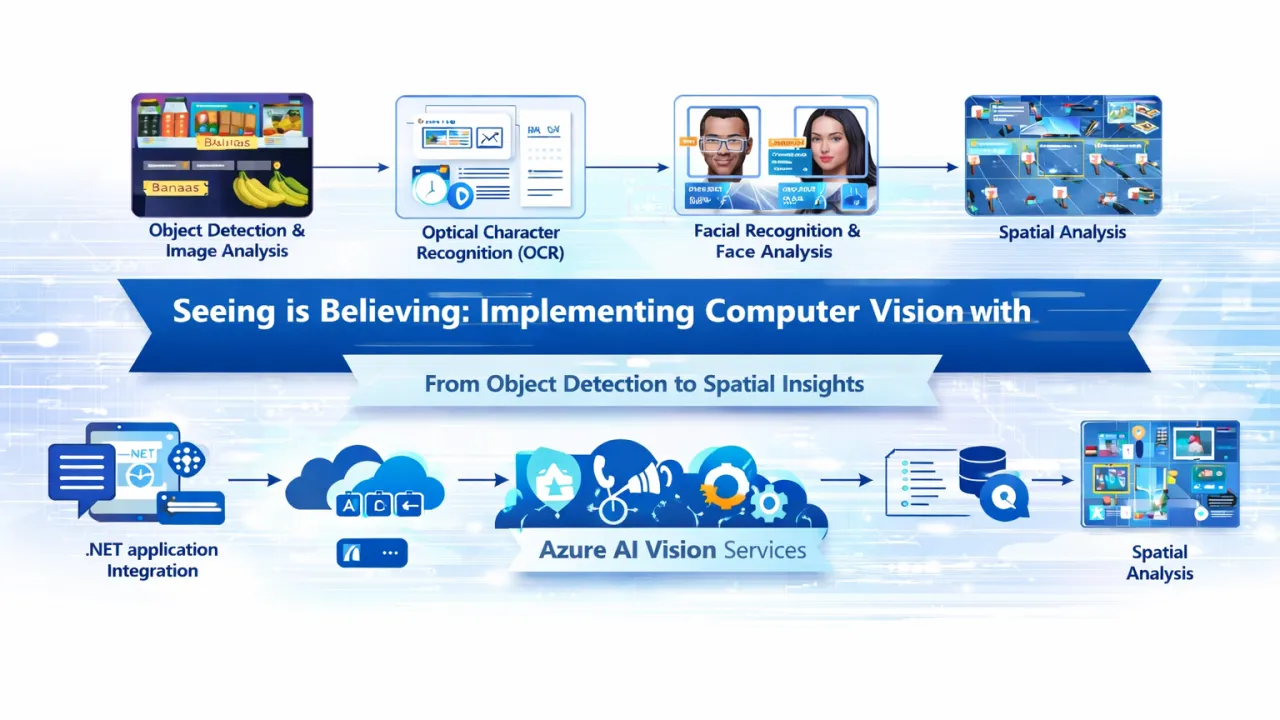
Computer vision has moved from experimental labs into everyday applications—powering automation, improving user experiences, and unlocking insights from visual data. With Azure AI Vision services from Microsoft Azure, .NET developers can easily bring advanced image and video understanding into real-world systems without building complex ML models from scratch.
This article explores practical computer vision scenarios and shows how .NET teams can integrate Azure AI Vision capabilities—such as object detection, facial recognition, OCR, image analysis, and spatial analysis—into production-ready applications.
🧠 Why Azure AI Vision for .NET Developers?
Azure AI Vision provides pre-trained, enterprise-grade models accessible through simple SDKs and REST APIs. For .NET developers, this means:
- Seamless integration with ASP.NET, APIs, desktop, and cloud apps
- No need for deep ML expertise
- Secure, scalable, and production-ready services
- Pay-as-you-go pricing aligned with real usage
👁️ Object Detection & Image Analysis
What it does
- Detects common objects (people, vehicles, products, animals)
- Analyzes scenes, tags, colors, and image content
- Identifies unsafe or restricted visual content
Real-world use cases
- Retail apps detecting products on shelves
- Manufacturing systems identifying defects
- Smart city solutions monitoring traffic and crowd density
.NET integration example (conceptual)
- Upload or stream an image from a web or API request
- Call Azure AI Vision SDK from a .NET service
- Parse detected objects and confidence scores
- Store or act on results in business workflows
🧾 Optical Character Recognition (OCR)
What it does
- Extracts printed and handwritten text from images and PDFs
- Supports multiple languages and document formats
- Preserves layout, tables, and line structure
Real-world use cases
- Invoice and receipt processing
- ID and document verification
- Digitizing forms and handwritten notes
Example scenario
A .NET-based finance system automatically extracts invoice numbers, totals, and dates from uploaded scans—eliminating manual data entry and reducing errors.
🙂 Facial Recognition & Face Analysis
What it does
- Detects faces and facial landmarks
- Analyzes attributes such as age range, emotion, and presence
- Supports identity verification (with responsible AI controls)
Real-world use cases
- Secure access control systems
- User verification in onboarding flows
- Personalized digital experiences
⚠️ Important: Facial recognition must be implemented responsibly, following regional compliance and ethical AI guidelines.
📐 Spatial Analysis (Vision at Scale)
What it does
- Analyzes video streams in real time
- Tracks movement, presence, and interactions in physical spaces
- Detects patterns across defined zones
Real-world use cases
- Retail footfall analytics
- Workplace safety monitoring
- Smart building occupancy insights
Example scenario
A .NET-powered dashboard visualizes real-time occupancy trends in a commercial space using spatial analysis data from connected cameras.
🔗 Integrating Azure AI Vision into .NET Applications
A typical architecture looks like this:
- .NET application (ASP.NET API, Web App, or Background Service)
- Azure AI Vision SDK or REST API call
- Secure authentication using Azure identity
- Process results (JSON response)
- Store insights in databases or trigger business logic
This modular approach allows vision capabilities to be reused across multiple applications and services.
📊 Monitoring, Scaling, and Optimization
Azure AI Vision services are built for enterprise workloads:
- Automatic scaling with demand
- Integrated logging and telemetry
- Performance monitoring through Azure tools
- Continuous model improvements without code changes
🏁 Final Thoughts
Computer vision is no longer a niche capability—it’s a competitive advantage. With Azure AI Vision services, .NET developers can rapidly build applications that see, understand, and react to visual information in real time.
From document processing and facial analysis to object detection and spatial insights, Azure AI Vision empowers teams to turn images and video into actionable intelligence—securely, responsibly, and at scale.
In modern applications, seeing truly is believing—and with Azure AI and .NET, it’s also achievable.