

Modernizing applications is rarely a straight jump from a legacy monolith to microservices. Yet many teams try to make that leap—and pay the price in complexity, instability, and operational overhead.
The truth is simpler: microservices are an outcome, not a starting point.
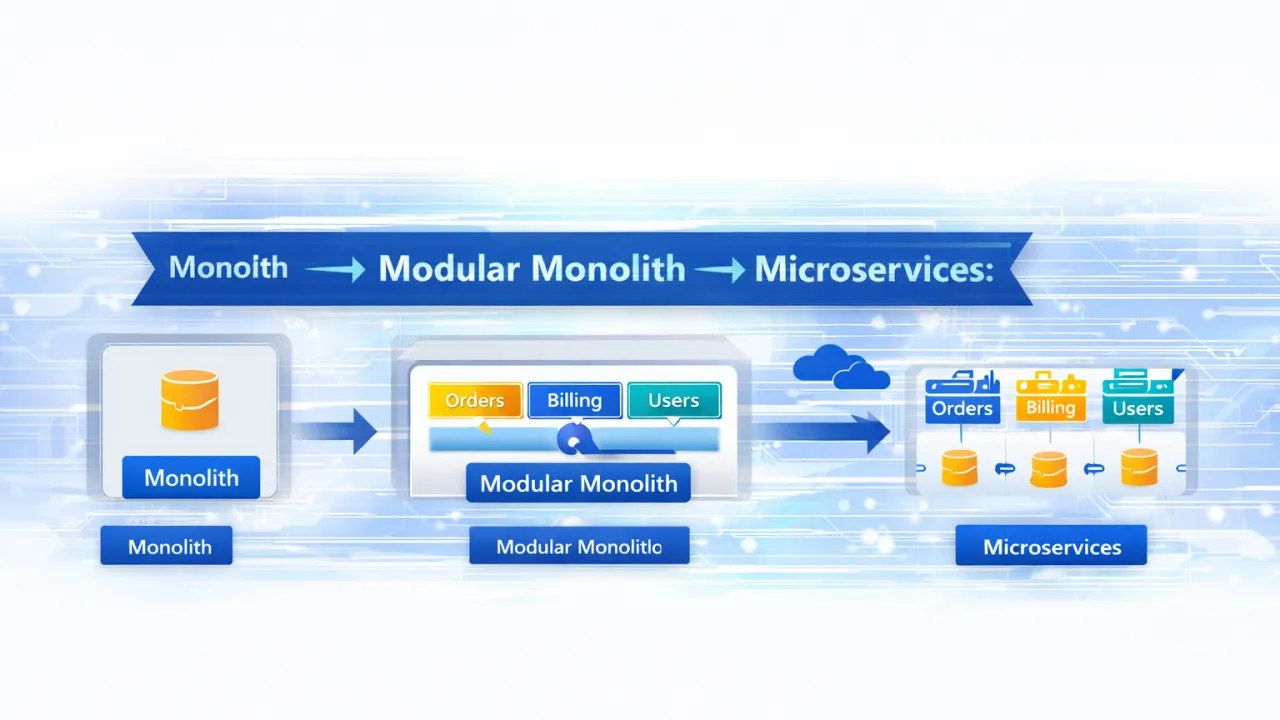
This article outlines a practical, Azure-friendly modernization journey that most successful teams follow: Monolith → Modular Monolith → Microservices Each stage has a purpose, benefits, and clear signals for when to move forward.
🧱 Stage 1: The Monolith (Where Most Teams Begin)
A monolithic application is a single deployable unit where:
- UI, business logic, and data access are tightly coupled
- Scaling happens as a whole
- A single failure can impact the entire system
Despite its reputation, the monolith isn’t inherently bad.
✅ Why Monoliths Still Make Sense
- Simple to develop and deploy early on
- Easy local debugging
- Lower operational complexity
- Faster initial delivery
❌ Where Monoliths Break Down
As systems grow, teams start to feel pain:
- Small changes require full redeployments
- Teams step on each other’s code
- Scaling is inefficient
- Long release cycles
- Increasing blast radius of failures
This is usually where teams start thinking about microservices—but jumping straight there is often a mistake.
🧩 Stage 2: The Modular Monolith (The Most Skipped—but Most Important—Step)
A modular monolith is still one deployable application, but internally it is:
- Logically separated into well-defined modules
- Enforced by code boundaries, not conventions
- Designed around business capabilities, not technical layers
This is the most critical phase of the journey.
🔑 Characteristics of a Modular Monolith
- Clear module boundaries (e.g., Orders, Billing, Users)
- Each module owns its domain logic
- Minimal cross-module dependencies
- Communication via interfaces, not shared data models
- No direct database access across modules
🧠 Why This Step Matters
If you can’t define clean boundaries inside a monolith, microservices will magnify the problem.
A modular monolith helps teams:
- Discover true domain boundaries
- Reduce coupling safely
- Improve testability
- Prepare teams for distributed thinking
- Avoid premature network calls
🛠 Azure-Friendly Implementation
In a .NET + Azure environment:
- Use solution-level modularization
- Apply Domain-Driven Design (DDD) concepts
- Enforce boundaries via assemblies and access rules
- Centralized deployment (App Service, Container Apps)
At this stage, you gain 80% of the benefits people expect from microservices—with 20% of the complexity.
🚀 Stage 3: Microservices (When—and Only When—it Makes Sense)
Microservices are independently deployable services that:
- Own their data
- Scale independently
- Communicate over the network
- Are operated and monitored separately
They shine only when the organization and architecture are ready.
✅ Signs You’re Ready for Microservices
- Stable, well-understood module boundaries
- Independent teams aligned to business capabilities
- Clear scaling or reliability needs per module
- Strong CI/CD practices
- Observability already in place
- Operational maturity exists
❌ Common Anti-Patterns
- Microservices created by technical layers
- Shared databases across services
- Excessive synchronous communication
- Distributed monoliths
- “Microservices because everyone else does it”
☁ Azure Microservices Stack (Practical, Not Fancy)
- Azure Container Apps or AKS for services
- Azure Service Bus / Event Grid for async communication
- Azure API Management for external access
- Azure Monitor + Application Insights for observability
- Managed identities for security
Microservices should simplify scaling and team autonomy, not complicate development.
🔄 Migration Strategy: How to Move Safely
Step-by-Step Approach
- Stabilize the monolith
- Refactor toward a modular monolith
- Enforce boundaries strictly
- Extract one module at a time
- Start with low-risk, high-value services
- Use async messaging to decouple
- Measure operational impact continuously
There is no “big bang” migration. Successful teams move incrementally and intentionally.
⚖ Trade-Offs to Acknowledge
Microservices introduce:
- Network latency
- Operational overhead
- Deployment complexity
- Distributed debugging challenges
They are not a free upgrade. They are a trade-off—worth it only when the benefits outweigh the cost.
🏁 Final Thoughts
Modernization is a journey, not a destination.
The most successful Azure teams don’t rush into microservices. They:
- Start with clarity
- Build strong modular foundations
- Let architecture evolve naturally
- Optimize for team productivity and system resilience
If you remember one thing, let it be this:
If your monolith isn’t modular, your microservices won’t be either.
Cloud-native architecture isn’t about how many services you deploy—it’s about how intentionally you design boundaries.