


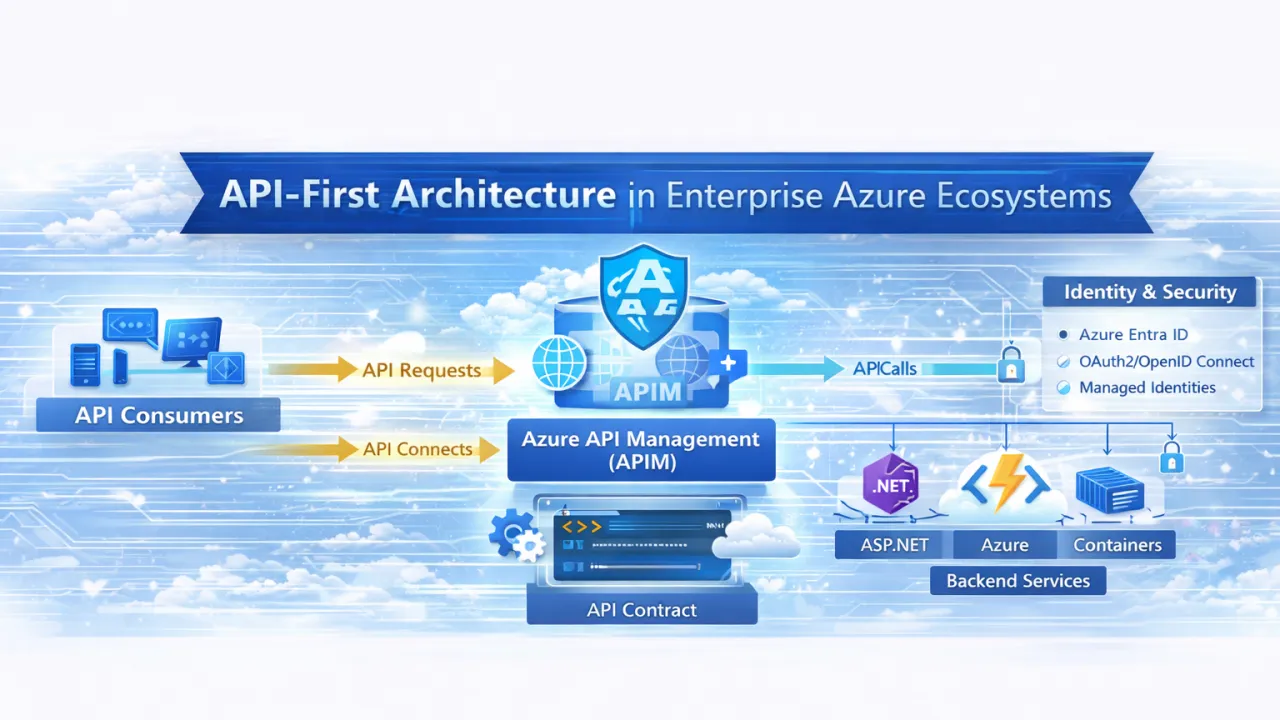
In modern enterprise Azure ecosystems, APIs are no longer just technical integration points—they are the primary interface through which systems, teams, and partners interact. As organizations scale, the number of consumers, platforms, and dependencies grows rapidly. Without a clear API strategy, this growth leads to tight coupling, fragile integrations, and slow delivery. API-first architecture addresses this challenge by treating APIs as first-class products rather than implementation by-products.
An API-first approach means designing the API contract before writing any business logic. Instead of exposing internal structures or database models, teams define clear, stable contracts that represent business capabilities. These contracts become the foundation for development, enabling backend services, frontend applications, and external consumers to evolve independently. In large Azure environments, this contract-driven model significantly reduces integration friction and prevents breaking changes from cascading across systems.
One of the biggest advantages of API-first architecture in Azure is organizational scalability. Enterprise platforms often involve multiple teams working in parallel. When APIs are well-designed and governed, teams can build, test, and deploy independently without constantly coordinating changes. Azure API Management (APIM) plays a central role here by acting as the unified entry point for APIs, enforcing security, throttling, versioning, and providing visibility into usage and performance.
Security is another area where API-first architecture proves critical. In enterprise systems, APIs define the boundary of trust. By centralizing authentication and authorization at the API layer—using Azure Entra ID, OAuth 2.0, and managed identities—organizations ensure consistent security policies across all consumers. This avoids the common anti-pattern of duplicating security logic inside every service, which often leads to inconsistencies and vulnerabilities.
API-first architecture also enables safe evolution over time. Enterprise APIs tend to live far longer than individual applications. When APIs are versioned intentionally and treated as long-term commitments, teams can introduce new capabilities without disrupting existing consumers. This stability builds trust across the organization and allows systems to modernize incrementally—whether by introducing microservices, serverless components, or legacy integrations behind the same API surface.
Importantly, API-first does not mean API-only. In mature Azure ecosystems, APIs often work alongside event-driven architectures. APIs handle commands and queries—explicit requests for data or actions—while events communicate outcomes and state changes asynchronously. This combination allows enterprises to build systems that are both predictable and scalable, without overloading APIs with responsibilities they were never meant to handle.
Ultimately, API-first architecture is not a tooling decision—it’s a mindset shift. It requires teams to think beyond their own codebases and consider consumers, longevity, governance, and change as core design concerns. Enterprises that adopt API-first principles on Azure gain more than clean integrations; they build platforms that are easier to scale, safer to evolve, and better aligned with long-term business growth.
In large Azure ecosystems, APIs are not just connectors—they are the architecture.