

In today’s cloud-first world, applications increasingly rely on messaging and event-driven architectures to ensure scalability, resilience, and real-time insights. Microsoft Azure offers multiple messaging services, with Azure Service Bus and Azure Event Hubs being two of the most widely used—but they serve very different purposes. Understanding their distinctions is critical to designing an efficient and reliable system.
Understanding Azure Service Bus
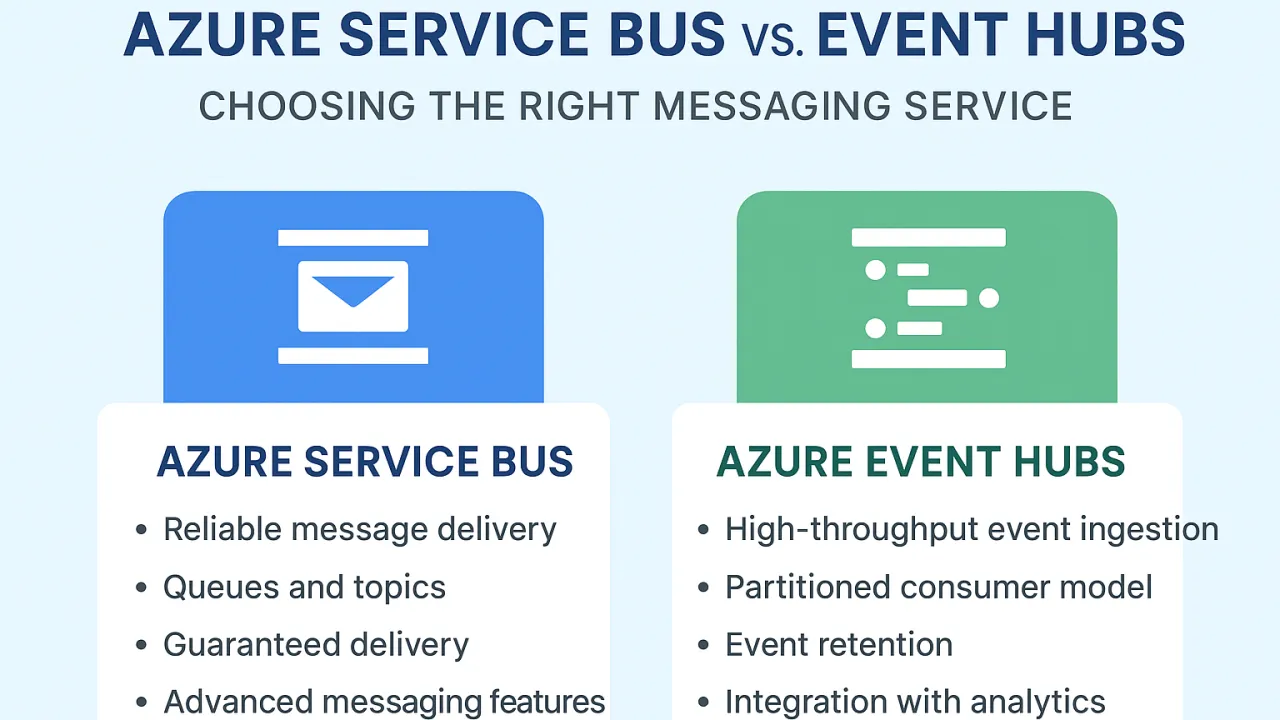
Azure Service Bus is a fully managed enterprise messaging platform designed for reliable message delivery between decoupled applications and services. Its key features include:
- Queues and Topics: Service Bus supports point-to-point messaging using queues and publish-subscribe patterns using topics and subscriptions.
- Guaranteed Delivery: It ensures once-and-only-once or at-least-once delivery with built-in message ordering and dead-lettering for failed messages.
- Advanced Messaging Features: Includes scheduled messages, deferred messages, duplicate detection, and transaction support.
- Integration: Ideal for microservices, order processing, and workflows where message reliability and ordering are critical.
Use Case Example: A financial application processing payment transactions needs guaranteed delivery, retries on failure, and the ability to process messages in order. Azure Service Bus fits perfectly here.
Understanding Azure Event Hubs
Azure Event Hubs is a big data streaming platform and event ingestion service designed to ingest millions of events per second from devices, applications, or sensors for real-time analytics. Its key capabilities include:
- High Throughput: Event Hubs can handle massive event streams with low latency.
- Partitioned Consumer Model: Events are written to partitions, allowing multiple consumers to process events concurrently.
- Event Retention: Events can be retained for hours or days, enabling replay and analytics scenarios.
- Integration with Analytics: Works seamlessly with Azure Stream Analytics, Databricks, and other big data services.
Use Case Example: A smart IoT deployment sending telemetry data from thousands of sensors every second requires high-speed ingestion for real-time processing and analytics. Azure Event Hubs is designed for this scale.
Choosing the Right Service
When deciding between the two services, consider your application requirements:
- Need reliable, ordered, and transactional message delivery? Go for Azure Service Bus. It ensures messages are delivered and processed exactly as intended, supporting complex enterprise workflows.
- Need to ingest massive volumes of events in real-time for analytics? Go for Azure Event Hubs. It’s optimized for high-speed event streaming and integration with analytics pipelines.
- Combining both patterns? Many architectures use Event Hubs for high-volume ingestion and Service Bus for downstream processing, orchestration, and guaranteed delivery to business applications.
Conclusion
Choosing the right messaging service in Azure is less about “better” or “worse” and more about matching the service to your workload requirements. Azure Service Bus excels at reliable, ordered, transactional messaging, while Azure Event Hubs shines in high-throughput event streaming and real-time analytics.