

In modern .NET development, creating software that is flexible, testable, and easy to maintain is more important than ever. As applications evolve, tightly coupled components can quickly become a barrier to adding new features, scaling systems, or improving performance.
This is where the Dependency Inversion Principle (DIP) steps in — offering a clear strategy for building loosely coupled, future-proof applications. When combined with Inversion of Control (IoC) containers, DIP becomes far more than a design principle; it becomes a practical, everyday part of clean architecture.
Understanding the Dependency Inversion Principle
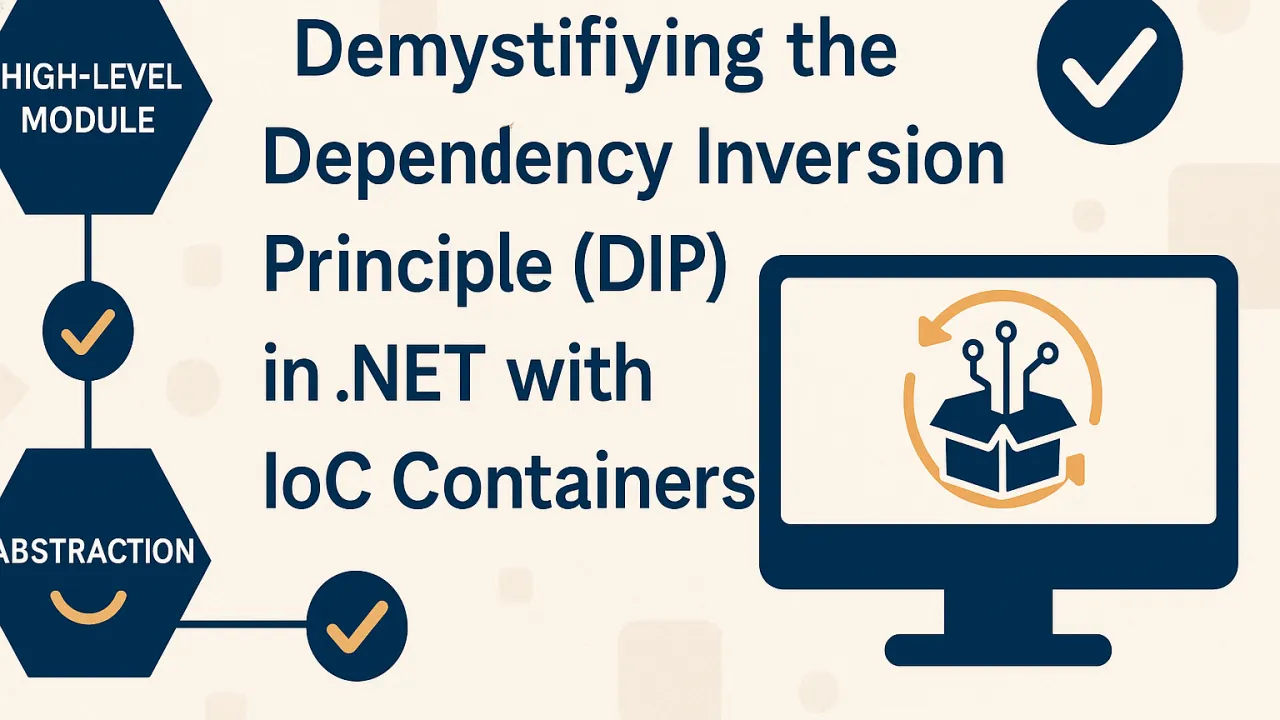
At its core, DIP guides developers to follow two key ideas:
1. High-level modules should not depend on low-level modules.
Both should depend on abstractions, not concrete implementations.
2. Abstractions should not depend on details.
Details (implementations) should depend on abstractions.
In simpler terms, instead of components depending on each other directly, they interact through well-defined contracts. This structure keeps the system resilient to change and encourages a modular, maintainable architecture.
Why DIP Matters in .NET Applications
In a typical application, core components often rely on specific classes, services, or data sources. When these dependencies are tightly coupled:
- Replacing or updating functionality becomes risky
- Testing individual components becomes difficult
- Code becomes harder to extend
- Maintenance effort increases significantly
By adopting DIP, we achieve:
✔ Better Testability
Components can be tested independently by substituting real implementations with lightweight alternatives.
✔ Reduced Coupling
Business logic remains isolated from technical details like data access, logging, or external services.
✔ Greater Flexibility
Features can be replaced or extended without breaking existing functionality.
✔ Cleaner Architecture
The system naturally aligns with layered or onion architecture patterns.
The Role of IoC Containers
While DIP defines the principle, Inversion of Control (IoC) containers make it practical. IoC containers automatically:
- Instantiate components
- Inject their dependencies
- Manage object lifetimes
- Resolve services only when needed
In .NET projects, IoC containers help enforce DIP seamlessly and consistently across the entire application.
Popular IoC containers include:
- • Microsoft.Extensions.DependencyInjection
The built-in .NET dependency injection framework — simple, lightweight, and ideal for most applications.
- • Autofac
A powerful, feature-rich container ideal for more complex dependency graphs or advanced scenarios.
- • Others like Ninject, StructureMap, Castle Windsor
Used in specific architectures depending on project needs.
IoC containers help ensure components depend only on abstractions — the container handles wiring the concrete implementations behind the scenes.
How IoC Containers Bring DIP to Life
IoC containers allow developers to:
1. Register abstractions and implementations
You define what service is used for what contract, without any class knowing the underlying details.
2. Automatically resolve dependencies
Instead of manually creating objects, constructors request abstractions and the container supplies the right implementation.
3. Control object lifetime
Singleton, scoped, transient — IoC containers manage how instances are created and reused.
4. Simplify unit testing
Mocks or test implementations can be swapped in easily through dependency registration.
5. Improve application structure
Startup configurations clearly define the system’s wiring, making architecture transparent and cleaner.
With IoC, DIP becomes not just a concept, but a practical, enforceable part of .NET development.
DIP + IoC = Clean, Scalable Architecture
When DIP is combined with IoC containers, the result is a clean, modular application design characterized by:
- • Clear separation of concerns
Business logic doesn’t know — or care — how dependencies work internally.
- • Plug-and-play components
New services or implementations can be added without modifying existing code.
- • Enhanced testability
Components rely on abstractions, making it easy to inject mock versions for testing.
- • Maintainable growth
As the application expands, the architecture remains stable and manageable.
Final Thoughts
The Dependency Inversion Principle is one of the most transformative ideas in software architecture — especially for .NET developers building modern, scalable applications. When supported by IoC containers like Microsoft.Extensions.DependencyInjection or Autofac, DIP creates systems that are not only easier to test and maintain but also ready to adapt to future business needs.
Following DIP isn't about writing more code — it's about writing better-structured code that makes your application stronger, cleaner, and more resilient in the long run.