

The Power Platform has rapidly evolved into a powerful ecosystem for building business applications through low-code tools such as Power Apps, Power Automate, and Power BI. While it excels at rapid development and citizen-developer enablement, complex enterprise requirements often demand capabilities beyond what low-code alone can offer.
This is where Azure and .NET development play a critical role.
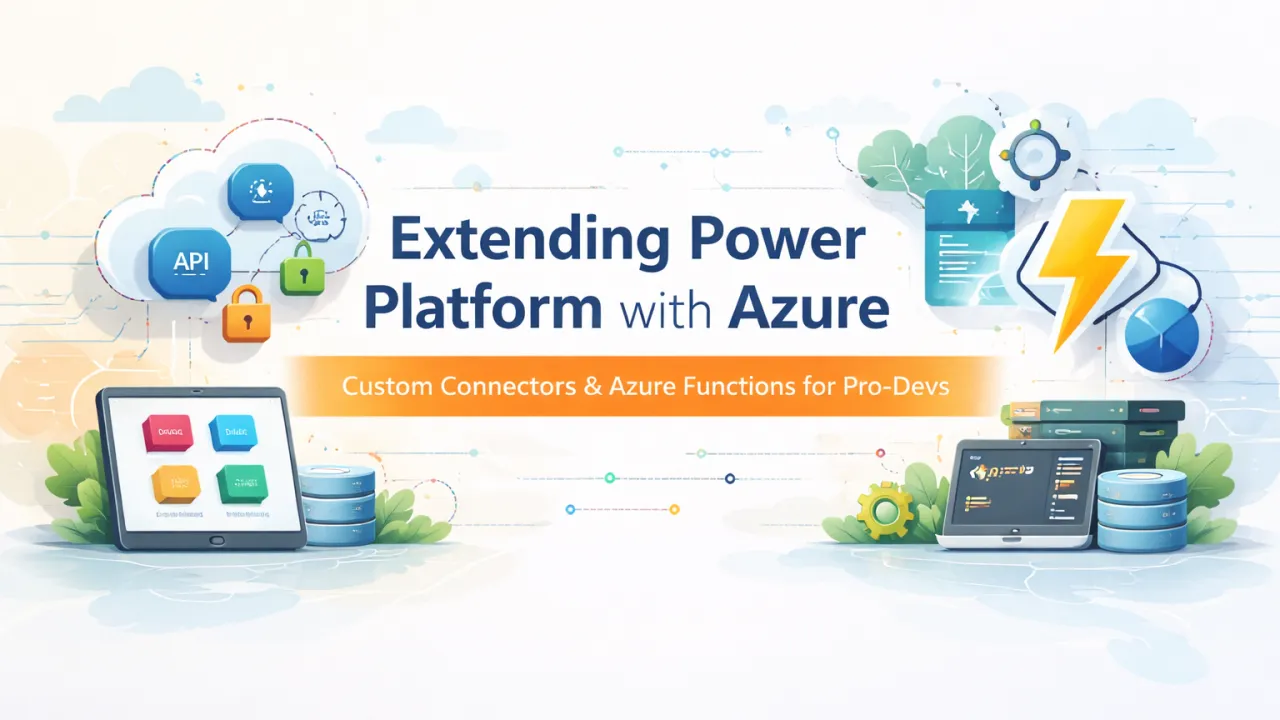
By combining Custom Connectors and Azure Functions, professional developers can extend the Power Platform in a scalable, secure, and maintainable way—effectively bridging the gap between low-code productivity and pro-code robustness.
The Low-Code and Pro-Code Divide
Low-code platforms are designed for speed and accessibility:
- Faster application delivery
- Reduced dependency on engineering teams
- Strong integration with Microsoft services
However, challenges arise when applications require:
- Complex business logic
- Advanced validation and orchestration
- Integration with legacy or proprietary systems
- High performance and scalability
- Fine-grained security controls
Rather than replacing low-code, professional developers enhance it by extending the platform with custom backend services built on Azure.
Custom Connectors: Opening the Door to External Systems
Custom Connectors allow Power Platform solutions to communicate with external services through well-defined APIs. They act as a bridge between Power Apps or Power Automate flows and custom backend logic.
Why Custom Connectors Matter
Custom Connectors enable:
- Secure access to internal or third-party APIs
- Reusable integration logic across multiple apps and flows
- Centralized API governance and versioning
- Cleaner separation between UI logic and backend services
For .NET developers, this means designing APIs with proper contracts, authentication, and error handling—while exposing them in a way that low-code tools can easily consume.
Azure Functions: The Pro-Code Engine Behind the Scenes
Azure Functions provide a serverless compute model that fits naturally with the event-driven nature of the Power Platform. They allow developers to focus on business logic without managing infrastructure.
Why Azure Functions Are a Natural Fit
Azure Functions are well-suited for:
- Stateless business logic execution
- Event-based processing triggered by Power Platform actions
- Scalable and cost-efficient workloads
- Integration with Azure services such as storage, messaging, and identity
They act as a powerful extension layer where complex rules, calculations, and integrations can be implemented using familiar .NET tooling and practices.
Bridging Low-Code and Pro-Code Effectively
When combined, Custom Connectors and Azure Functions create a clear architectural boundary:
- Power Platform handles UI, workflows, and user interaction
- Azure Functions handle business logic, validation, and integrations
- Custom Connectors expose backend capabilities in a controlled, reusable way
This separation ensures:
- Cleaner architectures
- Easier maintenance
- Better scalability
- Reduced duplication of logic across apps
Most importantly, it allows citizen developers and professional developers to collaborate without stepping on each other’s responsibilities.
Enterprise Considerations
For enterprise-grade solutions, this approach offers several advantages:
Security and Compliance
- Centralized authentication and authorization
- Controlled exposure of APIs
- Easier auditing and monitoring
Performance and Scalability
- Independent scaling of backend services
- Optimized processing for heavy workloads
- Reduced client-side complexity
Long-Term Maintainability
- Clear ownership of business logic
- Easier upgrades and refactoring
- Minimal disruption to low-code solutions when backend changes
When This Approach Makes the Most Sense
Extending Power Platform with Azure is particularly valuable when:
- Business logic is too complex for low-code expressions
- Multiple applications rely on shared backend rules
- Integrations must evolve independently of the UI
- Development teams want strong DevOps, testing, and versioning practices
In these cases, pro-code extensions do not slow down development—they enable sustainable growth.
Conclusion
The future of application development is not low-code versus pro-code—it is low-code plus pro-code.
By leveraging Azure Functions and Custom Connectors, .NET developers can extend the Power Platform in a way that preserves its agility while adding enterprise-grade capabilities. This hybrid approach empowers organizations to move fast without sacrificing quality, scalability, or architectural integrity.
Power Platform becomes the front door. Azure becomes the engine. Professional developers become the enablers.