


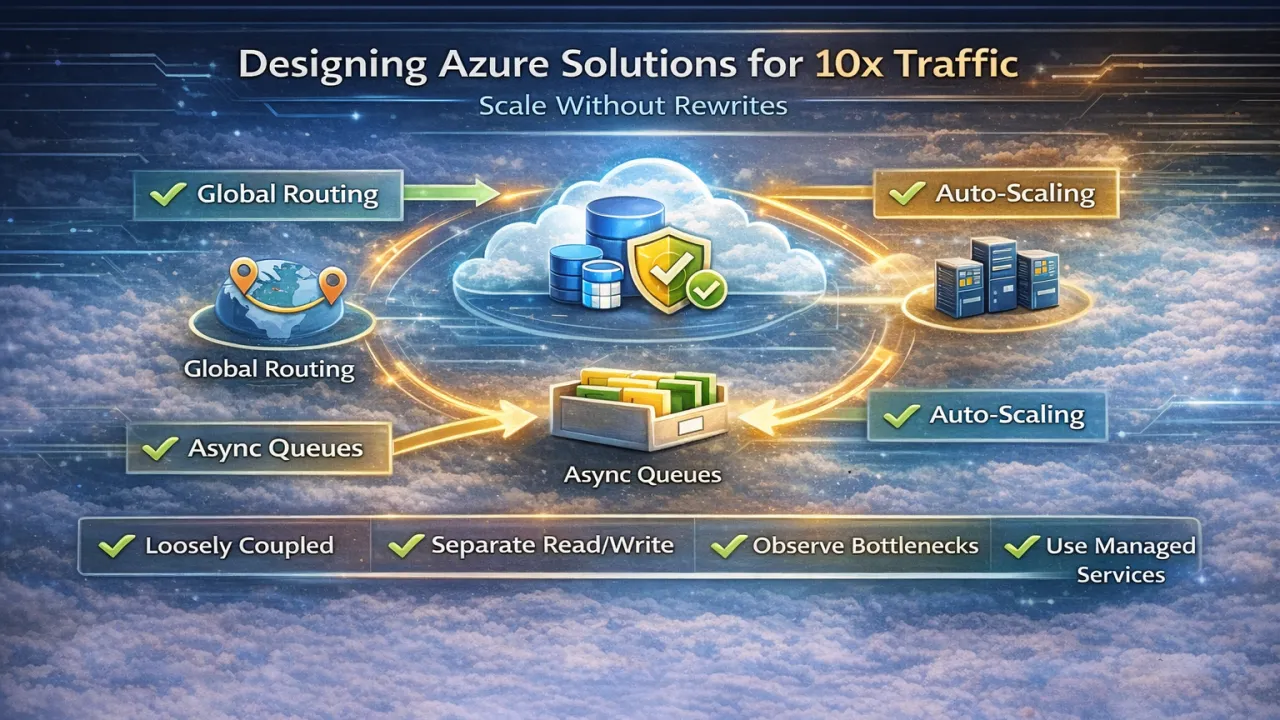
Most systems don’t fail because they can’t handle traffic—they fail because they were never designed to scale gracefully. When traffic grows 10×, teams often assume a rewrite is inevitable. In reality, large traffic increases rarely require new architectures; they require better architectural decisions early on.
Designing Azure solutions that scale by an order of magnitude without rewrites is about eliminating bottlenecks, embracing elasticity, and decoupling critical paths, not adding complexity.
Design for Scale at the Boundaries, Not the Core
The biggest mistake teams make is pushing scalability concerns deep into business logic. In well-designed Azure systems, scalability is handled at the edges—load balancing, messaging, caching, and throttling—while core business logic remains stable. When APIs, queues, and compute layers scale independently, the system absorbs traffic growth without invasive code changes.
This is why Azure-native services matter: they provide elasticity around your application instead of forcing your application to manage elasticity itself.
Favor Asynchronous Workflows Early
Synchronous request chains are the fastest way to hit scaling limits. When traffic spikes, synchronous dependencies amplify latency, exhaust threads, and cascade failures. Systems designed to handle 10× traffic push non-critical work into asynchronous flows using messaging, background processing, or event-driven patterns.
The result is simple but powerful: traffic becomes queue depth, not downtime. Your system stays responsive even when demand explodes.
Scale Reads and Writes Differently
Most traffic growth is not uniform. Reads often grow faster than writes, and treating them the same creates unnecessary bottlenecks. Azure solutions that scale well separate read-heavy paths from write-heavy ones—using caching, read replicas, or optimized query models—without changing core logic.
This separation allows teams to absorb traffic growth with configuration and infrastructure adjustments rather than refactoring application code.
Eliminate Shared Bottlenecks Before They Matter
Systems rarely fail everywhere at once—they fail at shared choke points. Common examples include centralized databases, synchronous integrations, or shared compute pools. Designing for 10× traffic means identifying these bottlenecks early and isolating them through partitioning, caching, or independent scaling units.
The goal is not infinite scalability—it’s predictable scalability.
Build Observability Before You Need It
You can’t scale what you can’t see. Systems that survive traffic spikes have strong observability long before those spikes occur. Metrics, tracing, and meaningful alerts allow teams to understand where load is increasing and why, enabling targeted scaling instead of reactive rewrites.
In Azure environments, observability is not optional—it’s the feedback loop that makes scaling decisions safe.
Let the Platform Do the Heavy Lifting
One of the biggest advantages of Azure is that many scaling problems are already solved—if you let the platform handle them. Auto-scaling compute, managed messaging, caching services, and global routing all exist to absorb growth without code changes. Teams that fight the platform tend to rewrite; teams that design with it rarely do.
Final Thoughts
Scaling to 10× traffic is not a heroic rewrite—it’s a design outcome.
Azure solutions that scale without rewrites share common traits: loose coupling, asynchronous boundaries, isolated bottlenecks, clear observability, and intentional use of managed services. When these principles are in place, traffic growth becomes a capacity planning exercise—not an architectural emergency.
The best scaling strategy is the one you don’t notice when traffic explodes.
Design for growth early, and your system will scale quietly—without drama, downtime, or rewrites.