

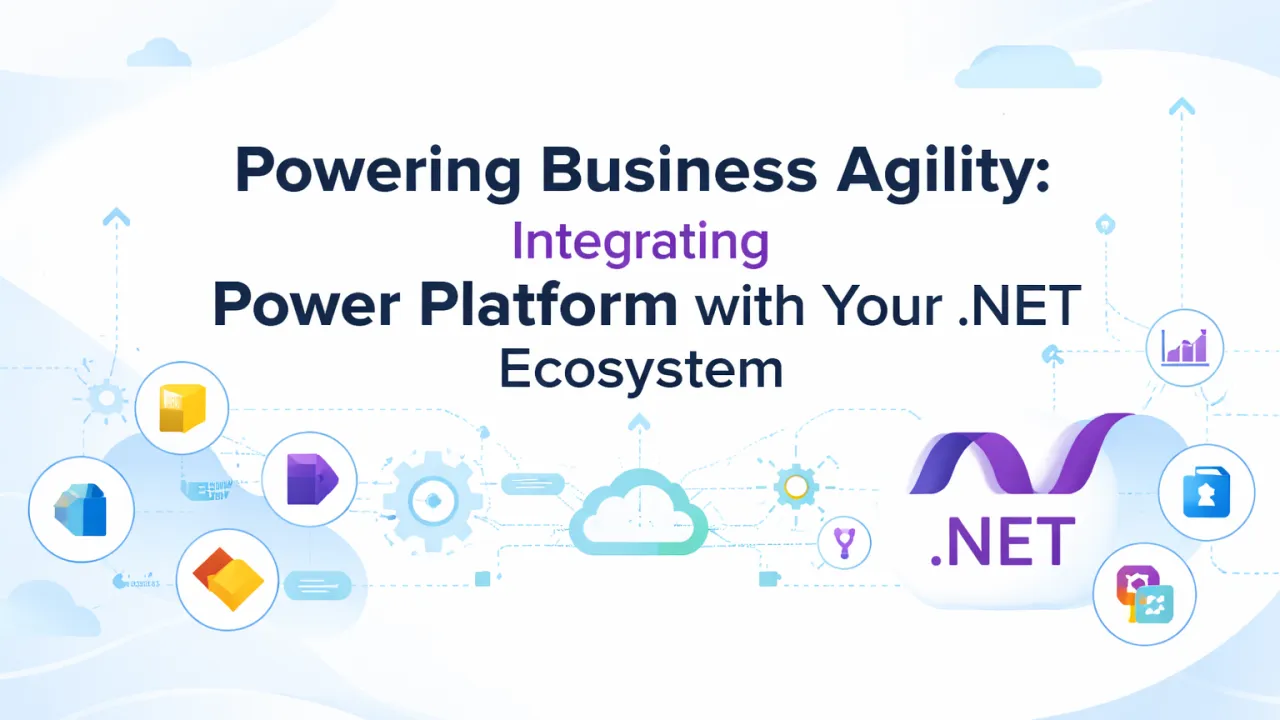
In today’s fast-moving digital landscape, organizations are under constant pressure to deliver solutions faster—without compromising scalability, security, or governance. This is where the Power Platform becomes a strategic accelerator, especially when integrated with an existing .NET ecosystem.
Rather than replacing professional development, Power Platform complements it—enabling a hybrid development model where citizen developers and .NET professionals collaborate to deliver business value at speed.
The Power Platform: A Catalyst for Rapid Business Solutions
The Power Platform—built by Microsoft—is designed to help organizations build solutions with minimal friction while staying connected to enterprise systems.
Power Apps: Turning Ideas into Applications
Power Apps enables teams to quickly build business applications using a visual, low-code approach. Business users can digitize manual processes, while IT maintains control through environments, permissions, and data policies.
Business impact:
- Faster app delivery
- Reduced dependency on long development cycles
- Greater alignment with real business needs
Power Automate: Intelligent Process Automation
Power Automate simplifies workflow creation by automating approvals, notifications, integrations, and repetitive tasks across systems.
Business impact:
- Elimination of manual handoffs
- Improved operational efficiency
- Faster response times across departments
Power BI: Insights that Drive Decisions
Power BI transforms raw data into interactive dashboards and reports that are easy to consume and share across the organization.
Business impact:
- Real-time visibility into KPIs
- Better, data-driven decision-making
- Reduced reliance on static reports
Where .NET Developers Add Strategic Value
While Power Platform empowers citizen developers, .NET developers play a critical role in extending, scaling, and governing solutions.
Extending Capabilities with Custom Connectors
Not every system is available out of the box. .NET teams can expose enterprise logic through APIs and custom connectors, making complex business functionality accessible inside Power Apps and Power Automate—without duplicating logic.
Result: Low-code apps powered by enterprise-grade backend services.
Azure Functions for Scalable Business Logic
Azure Functions allow .NET developers to encapsulate complex operations—such as validations, integrations, or calculations—and trigger them seamlessly from Power Platform flows or apps.
Result: Highly scalable, event-driven solutions that stay lightweight on the front end.
API-First Design for Long-Term Agility
By designing reusable APIs, .NET teams create a foundation that Power Platform solutions can consume today—and other applications can reuse tomorrow.
Result: Future-proof architecture with consistent business rules across platforms.
The Hybrid Development Advantage
The real power emerges when citizen developers and professional developers collaborate:
- Citizen developers focus on user experience and business workflows
- .NET developers ensure performance, security, and maintainability
- IT retains governance, compliance, and architectural control
This hybrid model reduces time-to-market while preserving enterprise standards.
Governance, Security, and Control
Enterprise adoption demands structure. With the right governance framework:
- Data Loss Prevention (DLP) policies protect sensitive data
- Role-based access ensures accountability
- Centralized monitoring maintains operational oversight
Power Platform does not weaken governance—it strengthens it when aligned with IT strategy.
Final Thoughts
Integrating Power Platform with your .NET ecosystem is not about choosing low-code or pro-code—it’s about using both intelligently.
Organizations that embrace this hybrid approach gain:
- Faster innovation
- Empowered teams
- Scalable and secure architectures
Business agility is no longer a buzzword—it’s a competitive advantage. And when Power Platform and .NET work together, that advantage becomes tangible.